Share this emailCopy the public link or share it on your favorite channel.

Last Call for 2025 Classes: Register for the Next PTB Big Exam Prep Workshop, Starting November 9

“Fall Back” into Your Exam Prep Routine with These Four Tips

Winter hours have officially landed. For much of the world, clocks turned back last Sunday. That means earlier sunsets, longer nights, and thrown-off schedules. For some, it can take weeks to fully adjust to the time change, and an off-kilter circadian rhythm can impact your sleep, performance, and overall sense of well-being. If your studying has taken a hit due to daylight savings, here are four tips to help you “fall back” into the swing of things.
#1: Seek Out Sunlight
The sun plays a key role in regulating your circadian rhythm. Getting out during the day, or even just sitting by a window with natural light, will help your body naturally adjust to the time change. While you can’t go wrong with getting any sort of sunlight, experts report that early evenings are the most beneficial. Exposure just before the sun sets will help your body delay sleep, allowing you to stay up later.

#2: Keep it Warm and Cozy
After you’ve squeezed out the last of the sunset, it’s time to turn on the lights. Believe it or not, lighting can have a Big impact on your environment– and how it makes you feel. According to Pepperdine University, warm lighting has been shown to promote positive feelings and have an overall larger impact on mood, compared to cooler lighting. Conversely, however, cooler lighting has been shown to promote focus and cognitive performance (which may be something to consider if you plan on any late-night study sessions).

#3: Stay Consistent
When it gets darker earlier, you may feel hungrier sooner than usual (and, consequently, more tired). Maintaining your regular routines will go a long way in helping you adjust to the time change. Whenever possible, try to stick to your usual schedule. Not only for the essentials, like eating and sleeping, but for your day-to-day activities (like studying).

#4: Stay Active
Beyond light, exercise is another way to help regulate your circadian rhythm. Physical activity in the morning has been shown to speed up your body’s internal clock, helping you feel more awake and alert. If you prefer to exercise in the evening, that’s fine, too. Just be cautioned that the effects are the same, and a vigorous workout could make it harder to fall asleep later.
There are only two more chances to go Big in 2025. The final classes for the PTB Big Exam Prep Workshop start soon. Get PTB’s most comprehensive prep protocol with 6 weeks of mock exams, live lectures, study halls, and more.

The next workshop begins this Sunday, November 9, at 10:00 a.m. PST.

High Stakes Test Prep: Advice for Your Last Attempt at the BCBA® Exam

If you think of time sampling and interval recording when you hear discontinuous measurement, you’re not wrong, but there’s more to the story. PTB founder Dana Meller explains two other discontinuous measurement methods you should know.
Looking for more practice with Domain C? Get flexible, targeted prep with the PTB Mini Mocks series. Each PTB Mini Mock covers a specific TCO Domain– and every item within that Domain– with 30 peer-reviewed questions, plus detailed rationales and explanations included in the score report.

Prep a la carte with individual PTB Mini Mocks or get the complete series for 270 questions in total.

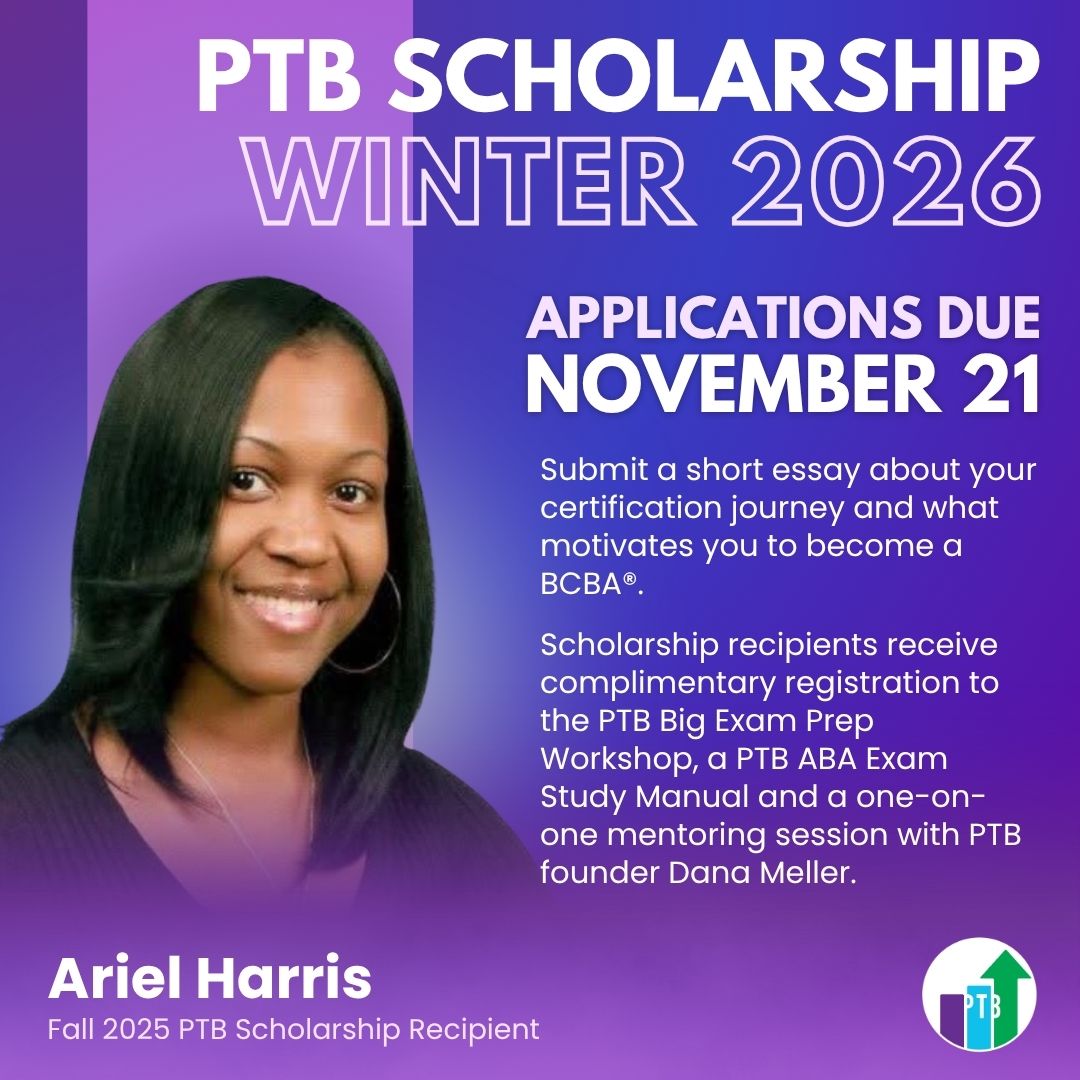
OPEN NOW: Submit Your Application to the Winter 2026 PTB Scholarship

Awarded seasonally, the PTB Scholarship is offered as part of PTB’s mission to support students throughout their certification journey. Recipients receive complimentary registration to the PTB Big Exam Prep Workshop, a PTB ABA Exam Study Manual, and a one-on-one mentoring session with PTB founder Dana Meller.

The application period for the winter 2026 PTB Scholarship is open now through November 21. For consideration, submit a short essay and tell PTB what motivates you to become a BCBA®. You could receive the PTB Scholarship and your story could inspire your fellow students.

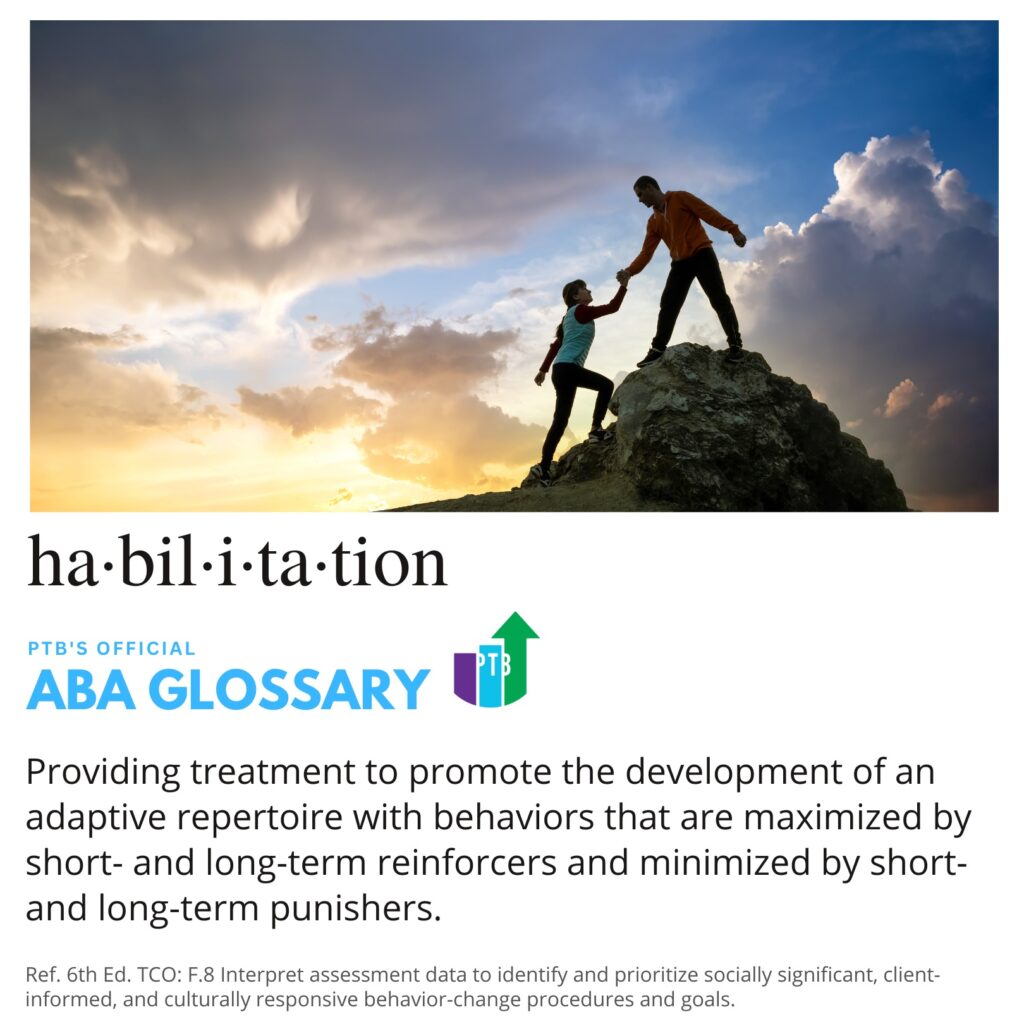
Word of the Week: Habilitation

Check out PTB's official online glossary with 528 essential ABA terms. Created by PTB founder Dana Meller, MA, BCBA and edited by Tyra Sellers, J.D., Ph.D., BCBA-D.

FOLLOW PTB

email website instagram facebook linkedin youtube