BEPW

FIRST 2027 WORKSHOPS: Tue. Jan 5 @ 3 PM - 6:30 PM (PDT) OR Sun. Jan 10 @ 10 AM - 1:30 PM (PDT)I Live Class Video Replays I REGISTER NOW

previous arrow
next arrow

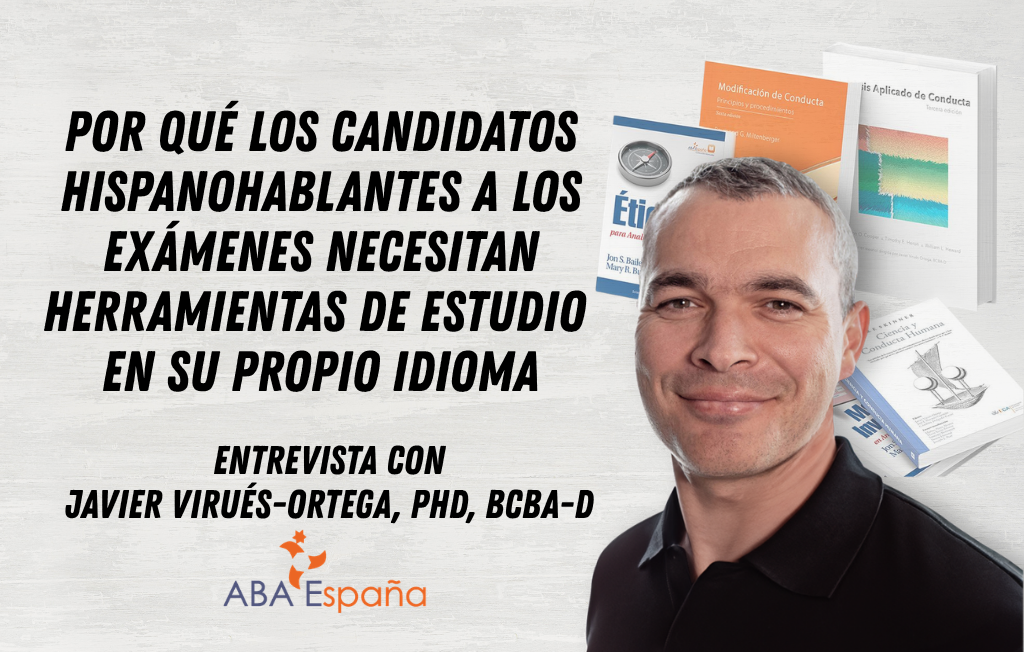
Por Qué los Candidatos Hispanohablantes a los Exámenes Necesitan Herramientas de Estudio en su Propio Idioma: Entrevista con Javier Virués-Ortega, PhD, BCBA-D

Read the Q&A in English.

Acerca del Dr. Javier Virués-Ortega, PhD, BCBA-D: Autor, investigador, profesor asociado de psicología en la Universidad de Auckland (Nueva Zelanda), miembro de la junta directiva de ABA España y revisor técnico del Manual de estudio para el examen PTB ABA (en español).

Psicólogo clínico y analista conductual, el Dr. Virués-Ortega ha formado parte de los consejos editoriales de ocho revistas líderes en el ámbito del análisis conductual y ha desempeñado cargos de responsabilidad en la Junta de Certificación de Analistas Conductuales (BCBA®) y en la Asociación Europea de Análisis Conductual.

Como miembro ejecutivo de la junta directiva de ABA España, una plataforma de formación internacional con más de 40,000 estudiantes y profesionales, sigue avanzando el análisis conductual en el mundo hispanohablante.

El examen BCBA® solo se ofrece en inglés, pero muchas de las personas que se preparan para él piensan, trabajan y atienden a las familias en español. Para ellas, el reto no suele ser la ciencia en sí misma, sino demostrar lo que saben en una segunda lengua, bajo presión, en un examen en el que pequeñas diferencias en la redacción cambian el significado de una pregunta.

Javier Virués-Ortega, Dr., BCBA-D, de ABA España, lleva años trabajando en este problema. A través de las publicaciones y la formación de ABA España, así como de su colaboración con la Universidad de Cádiz, ha contribuido a que la literatura fundamental sobre análisis conductual, incluido el texto de Cooper, esté al alcance de los profesionales hispanohablantes. También ha ejercido como revisor técnico del «Manual de estudio en español del examen ABA de PTB».

Le preguntamos al Dr. Virués-Ortega por la situación de los recursos sobre ABA en español, cómo deben balancear los candidatos la comprensión de su lengua materna con fluidez en inglés, qué tenía en  cuenta al revisar la traducción y hacia dónde podría dirigirse la certificación para los países de habla hispana.

Para quienes aún no conocen ABA España, ¿habanos de su misión institucional y su comunidad?

La misión de ABA España es facilitar el acceso a una formación de calidad y basada en la evidencia en análisis aplicado de conducta en español. Nuestro trabajo se centra en la formación de profesionales, la actividad editorial, la divulgación y, en menor medida, la investigación. Nos dirigimos a estudiantes, analistas de conducta, profesionales de la psicología, de la educación y de otros ámbitos interesados en aplicar la ciencia de la conducta a problemas de importancia social. También elaboramos recursos para familias y cuidadores. A lo largo de nuestros más de 20 años de trayectoria, y en años recientes especialmente a través de nuestro partner la Universidad de Cádiz, hemos formado a cientos de profesionales el mundo de habla hispana.

¿Qué disponibilidad hay hoy de recursos de ABA de calidad en español, en comparación con los que existen en inglés?

La situación ha mejorado mucho en la última década, pero siguen existiendo limitaciones. Los profesionales angloparlantes tienen a su alcance una oferta amplísima de manuales, publicaciones científicas, formación continua y herramientas de preparación de exámenes. En español, la oferta sigue siendo bastante más reducida, especialmente en temas avanzados o especializados. Cuando empezamos a publicar manuales en ABA España, muchas de las obras fundamentales de nuestra disciplina no estaban disponibles en español (todavía había quien recurría a ediciones de los años setenta de las míticas Fontanella o Trillas). Hoy contamos con una variedad razonablemente amplia de materiales de todo tipo en nuestro idioma, no obstante, aun queda mucho por hacer.

ABA España ha publicado más de 25 títulos en español, entre ellos el conocido libro de Cooper. ¿Qué habéis aprendido sobre lo que necesitan los profesionales de habla española?

Una de las principales lecciones es que los profesionales no necesitan necesariamente una ciencia simplificada: necesitan ciencia rigurosa, explicada en un idioma que puedan comprender en profundidad. En el caso de traducciones de manuales como el que mencionas, traducir es mucho más que sustituir palabras por sus equivalentes en español. Exige desarrollar una terminología técnica coherente que conserve el significado funcional de los conceptos conductuales. También hemos aprendido que los estudiantes valoran los ejemplos prácticos, las explicaciones claras y los materiales que conectan los principios fundamentales con las decisiones clínicas del día a día. Nuestras publicaciones abarcan desde textos introductorios hasta obras avanzadas sobre diseño experimental, ética o conducta verbal, por mencionar algunos ejemplos.

Dado que el examen para la certificación BCBA® solo se ofrece en inglés, ¿por qué crees que es importante contar con herramientas de preparación en español?

Porque dominar la disciplina y dominar el inglés son dos cosas distintas. Una persona puede conocer perfectamente los programas de reforzamiento, la evaluación funcional o el diseño experimental y, aun así, tener dificultades para demostrar lo que sabe cuándo el examen se realiza en un segundo idioma. Los materiales de calidad en español permiten construir una base conceptual sólida sin añadir barreras lingüísticas innecesarias. Esto es especialmente importante cuando hablamos de conceptos científicos complejos que exigen distinguir matices con precisión. Por supuesto, quienes se presentan a exámenes de certificación también deben familiarizarse con la terminología inglesa (incluso en certificaciones de alcance internacional, lo habitual es que los exámenes se ofrezcan en inglés). No se trata de sustituir la preparación en inglés, sino de hacer más eficaz el proceso de aprendizaje.

¿Cómo deberían compaginar los candidatos la comprensión de la materia en su lengua materna con el dominio del inglés?

Les animaría a diferenciar entre aprender la ciencia y aprender a demostrar lo que saben en inglés. Son dos procesos que deben complementarse. En las primeras etapas, estudiar en español puede facilitar la comprensión de principios complejos y evitar una carga cognitiva innecesaria. Ahora bien, si su objetivo final es examinarse en inglés, conviene incorporar progresivamente la terminología inglesa, las lecturas técnicas y las preguntas de práctica en ese idioma. Los glosarios bilingües y las ediciones con los textos en ambos idiomas en paralelo pueden ser especialmente útiles para establecer correspondencias entre los conceptos en las dos lenguas.

Cuando hablas con hispanohablantes que van a presentarse al examen, ¿qué te cuentan que les resulta más difícil de estudiar en español y examinarse en inglés?

Uno de los mayores retos es el esfuerzo adicional que requiere interpretar preguntas técnicamente complejas en un segundo idioma, especialmente bajo la presión de un examen con importantes consecuencias profesionales. Los exámenes de ABA suelen exigir distinguir matices muy sutiles entre conceptos, y los candidatos tienen que captar diferencias lingüísticas que conllevan diferencias de significado. Un detalle aparentemente menor puede cambiar por completo el sentido de un escenario. Esto puede resultar especialmente difícil para quienes han estudiado los conceptos principalmente en español y apenas han tenido contacto con la jerga profesional en inglés (también para personas con un nivel de lectura medio-bajo de entrada en cualquier idioma). Esta dificultad puede acabar distorsionando el propio proceso de aprendizaje: algunos estudiantes terminan centrándose en «preparar el examen» en lugar de aprender análisis de conducta como tal. Contar con un recurso como PTB Examen ABA Manual de Estudio en español nos parece una excelente opción que podemos recomendar a los estudiantes para afrontar retos lingüísticos que nosotros no podemos afrontar cuando impartimos contenido.

¿Qué te llevó a colaborar con PTB para preparar una edición en español de este conocido manual de estudio?

Esta colaboración es una continuación natural de lo que llevamos muchos años haciendo en ABA España. Hemos dedicado mucho esfuerzo a poner a disposición de la comunidad hispanohablante obras fundamentales de análisis de conducta, con frecuencia de forma desinteresada. PTB ha desarrollado un sistema consolidado de preparación de exámenes que organiza una gran cantidad de contenido científico en un recurso de aprendizaje práctico y accesible. Llevar ese enfoque a los estudiantes de habla española permite complementar los manuales existentes con una herramienta de estudio estructurada. Nos interesaba especialmente que la edición en español mantuviera el rigor conceptual y la coherencia terminológica con nuestra colección de obras de referencia ya publicadas.

Como revisor técnico, ¿qué aspectos consideraste imprescindibles en la traducción para poder recomendar el producto?

Mi principal preocupación era la precisión lingüística y científica. En análisis de conducta, la terminología es fundamental, sutilezas de redacción pueden alterar por completo la recepción de un concepto por parte del estudiante. Y esto no se aplica solo a la traducción de términos propios de ABA, sino también a la contextualización, los ejemplos, las referencias culturales, etc. En definitiva, una buena edición traducida es aquella que conserva la naturalidad del lenguaje para el lector nativo sin perder la precisión científica ni el valor didáctico del original.

Más allá de la preparación de exámenes, ¿cómo crees que se puede utilizar el manual, por ejemplo, entre supervisores, formadores o profesionales clínicos que trabajan con familias hispanohablantes?

Creo que el manual tiene mucho valor más allá de la preparación de un examen de certificación. El profesorado universitario puede utilizarlo para organizar actividades docentes y reforzar la terminología esencial. También puede servir a los profesionales clínicos como material de consulta rápida cuando necesiten repasar principios conductuales o explicar los fundamentos conceptuales de una intervención.

¿Se está avanzando en el desarrollo de certificaciones propias en otros países hispanohablantes que quedan fuera del ámbito geográfico del examen de la BACB?

Hay avances alentadores, aunque la situación varía considerablemente de un país a otro. Desde que se limitó geográficamente el acceso a certificaciones profesionales en 2020, las organizaciones profesionales de Latinoamérica y España se han centrado cada vez más en desarrollar estándares formativos, promover una práctica ética y reforzar el reconocimiento profesional. No obstante, grupos con un determinado interés profesional dista considerablemente de la creación de un sistema nacional de certificación. Para desarrollar una certificación sólida y creíble hace falta una infraestructura importante: estándares de competencia, requisitos de práctica supervisada, exámenes válidos, supervisión ética y reconocimiento en el entorno profesional y normativo de cada país, por no hablar de las inversiones económicas. Todo ello ha hecho que, por ahora, no se haya materializado un proyecto de certificación específico en español. No obstante, hay proyectos prometedores que quizá vean la luz en el futuro. ¡Veremos qué pasa! Entretanto, QABA e IBAO ofrecen alternativas (aunque sus exámenes no están disponibles en español).

Has mencionado QABA® e IBAO®, ¿cómo pueden ayudar los materiales de preparación para el examen de BCBA a quienes optan a certificaciones específicas de un país o a las de QABA e IBA, cuyos exámenes se realizan en español?

Los principios fundamentales del análisis de conducta son universales, independientemente de la entidad que gestione un determinado marco de certificación profesional. Por tanto, los materiales de preparación de PTB también pueden tener un valor formativo considerable para quienes aspiran a las certificaciones QBA o IBA, incluidas las personas que se examinan en español. Ahora bien, los sistemas de certificación no son idénticos. Los candidatos deben comparar cuidadosamente los estándares de competencia correspondientes y completar su preparación con los contenidos específicos que se recomiendan para la certificación que desean alcanzar. Las futuras ediciones de PTB, especialmente las de su versión española, podrían incorporar materiales adicionales que ayuden a identificar los contenidos exigidos por los distintos marcos de certificación profesional.
Recursos para los exámenes IBA® y QBA®:

Exam Prep Tips. Delivered Weekly.

Be the first to get the latest access to resources, news, and exclusive offers from PTB, delivered to your inbox.

We don’t spam! Read our privacy policy for more info.

  • Study Manual
  • Related Content

  • Why Spanish-Speaking BCBA® Exam Candidates Need Study Tools in Their Own Language: Q&A with Javier Virués-Ortega, PhD, BCBA-D
    Many future BCBAs think and practice in Spanish but must prove their knowledge on an exam offered only in English. Javier Virués-Ortega, PhD, BCBA-D, of ABA España, who served as technical reviewer for the Spanish edition of the PTB ABA Exam Study Manual, shares his view on the resource gap, the language barrier, and how candidates can prepare.
  • Por Qué los Candidatos Hispanohablantes a los Exámenes Necesitan Herramientas de Estudio en su Propio Idioma: Entrevista con Javier Virués-Ortega, PhD, BCBA-D
    Muchos futuros BCBAs piensan y practican en español, pero deben demostrar sus conocimientos en un examen que solo se ofrece en inglés. Javier Virués-Ortega, Dr., BCBA-D, de ABA España, quien sirvió como revisor técnico de la edición en español del «Manual de estudio para el examen PTB ABA», comparte su opinión sobre la falta de recursos, la barrera lingüística y cómo pueden prepararse los candidatos.
  • Dana Do's: How to Breakdown BCBA® Exam Questions When English is Not Your First Language
    Taking the BCBA® exam in a language that isn’t your first can add an extra layer of difficulty—even when you know the ABA content. PTB founder Dana Meller offers practical strategies for navigating complex wording and focusing on the information that matters most.
  • Dana Do's: Rules of Thumb for 'What Would You Do First?' on BCBA® Exam Questions
    "What would you do first?" questions can often comes down to sequence, PTB founder Dana Meller offers a set of common scenarios where the order of operations matters.
  • Dana Do's: What Comes First? An Exam Tip to Crack These BCBA® Test Questions
    When a BCBA® exam question asks what should happen “first,” every answer choice may sound reasonable. PTB founder Dana Meller offers a trick to recognizing what the question is really asking.
  • Dana Do's: How to Mitigate the Four R's of Relapse
    PTB founder Dana Meller revisits the topic of relapses with a follow up breakdown on how to mitigate the return of target behaviors.
  • Dana Do's: Understanding Functional Analysis (FA) to Navigate BCBA® Exam Questions
    If you’ve never conducted or observed a functional analysis, FA questions on the BCBA® exam can feel especially abstract. PTB founder Dana Meller helps you visualize what’s happening in an FA and what to look for when interpreting exam scenarios.
  • Dana Do's: Identify the Type of Relapse on BCBA® Exam Questions
    PTB founder Dana Meller offers tips on how to identify the correct type of relapse on the BCBA® exam questions.
  • Rest Assured: Four Tips for Better Sleep Before the Big Exam
    Studying for the BCBA® exam and feeling sleep-deprived? Quality rest is key to staying focused and retaining information, but it’s often the first thing to suffer when life gets busy. If you’re struggling to unwind, PTB has rounded up a few tips to help you sleep more soundly and stay refreshed on your exam journey.
  • Ethically Speaking: BCBA® Exam Questions Addressing Personal Bias
    Consider how personal biases might show up in questions on the BCBA® exam. PTB scholar-in-residence Tyra Sellers, J.D., Ph.D., BCBA-D explains.
  • Four Tips for Summer Studying
    Studying for the BCBA® exam this summer? PTB shares four easy, seasonal tips to help you stay on track—without missing out on the sunshine and fun.
  • Four Ways to Study Before the Workshop
    If you’re not sure how to prep before you study with the PTB Big Exam Prep Workshop, here are four tips to help you get started.
  • Three Tips to Help You Spring Forward
    Ready to spring forward with your study plans for the BCBA® exam? PTB has three tips to help you get a jump.
  • Three Science-Backed Tips for Better Concentration
    It can be hard to make progress when attention is at a premium, and an endless stream of distractions is just a scroll away. If you’re struggling to find your focus, PTB has three science-backed strategies for improving your concentration.
  • Three Ways Hobbies Improve Your Health
    New year, new you. With the start of a new year, many people are looking to start a new hobby (or rediscover a previous one). Making time for what you’re…
  • 6 Self-Care Tips for the Holidays
    The holidays are here and ‘tis the season for stuffed schedules, mile-long to-do lists and a whole heap of added stress. Self-care is especially important during this time of year,…
  • 5 Tips for Better Concentration
    These days, there is always something that seems to be demanding your attention. Smart phones, social media, emails, text messages, group chats… The notifications are endless– as are the distractions.…
  • Dana Do's: What the BACB® Wants You to Understand About ABA vs. Professional Practice Guided by the Science of Behavior Analysis
    Confused by ABA versus the professional practice guided by the science of behavior analysis? If so, PTB founder Dana Meller has got you.
  • 6 Ways Gratitude Can Improve Your Health
    It’s the time of year when gratitude is top of mind, just a little more than usual. Believe it or not, expressing and feeling gratitude has been shown to have…
  • Four Productivity Tips to Squeeze into Your Busy Schedule
    Feel like 24 hours just isn’t enough sometimes? For a BCBA® exam candidate, chances are, it’s not. Busy days can lead to overbooked schedules and feeling overwhelmed. If you’re on…
  • Dana Do's: Understanding Discontinuous Measurement Methods
    Beyond time sampling and interval recording, there are two other discontinuous measurement methods PTB founder Dana Meller believes you should know for the BCBA® exam.
  • Dana Do's: How Baseline Logic Connects to ABA Experimental Designs
    Baseline logic is one of the most essential — yet often confused — concepts on the BCBA® exam. PTB founder Dana Meller breaks it down.
  • Q&A: PTB's Scholar-in-Residence, Dr. Tyra Sellers
    Learn what PTB's scholar-in-residence Dr. Tyra Sellers, J.D., Ph.D., BCBA-D, hopes to contribute to BCBA® exam prep for certification candidates, agency partners, and universities.
  • Dana Do's: Breaking Down Behavior-Altering Versus Value-Altering Effects
    Learn the key distinctions between value-altering effects and behavior-altering effects with this quick lesson from PTB founder Dana Meller.
  • Dana Do's: An Important Study Tip on Applying Knowledge to BCBA®/BCaBA Exam Questions
    Advice from PTB founder Dana Meller on what to do when your knowledge of general concepts, definitions, and ideas is not generalizing to nuanced and contextualized test questions.
  • 5 Tips for Better Reading Comprehension
    Memorization, application, and comprehension, or M.A.C. skills as PTB founder Dana Meller likes to call them, are the fundamentals of BCBA® exam prep. They all work together to ensure you…
  • 5 Tips for More Organized BCBA® Exam Prep
    The journey to exam day can get a little chaotic. To combat feeling overwhelmed, it’s important to have management strategies in place. To help you get your exam prep in order, PTB has rounded up 5 tips for better organization.
  • Dana Do's: Understanding the Difference Between Differential Reinforcement Procedures
    PTB founder Dana Meller clears up the key difference between differential reinforcement procedures.
  • How Much Does it Cost to Take (Or Retake) the BCBA® Exam?
    If you’re gearing up for the next phase of your certification journey, chances are, you’re wondering what sort of investment it requires. So, how much does it actually cost to take the BCBA® exam? Let’s crunch the numbers.
  • Dana Do's: Key Differences Between Ratio Strain and Breaking Point
    Confused about ratio strain vs. breaking point? Learn how abrupt changes in reinforcement can lead to avoidance and aggression (ratio strain), while increased effort with no change in reinforcement can cause behavior to stop altogether (breaking point).
  • Learn how the BCBA® exam is scored, and what score you should aim for to improve your chances of passing.Dana Do's: How the BACB® Scores the BCBA® Exam
    Learn how the BCBA® exam is scored, and what score you should aim for to improve your chances of passing.
  • Dana Do's: Avoid BCBA® Exam Scams
    Avoid BCBA® exam scams on social media. Learn how to spot fake offers, protect your money, and stay ethical in your test prep.
  • How do you discriminate between operant behavior and respondent behavior on test questions? PTB founder Dana Meller shows you the ABC of it.Dana Do's: How to Discriminate Between Operant Behavior and Respondent Behavior on BCBA® Exam Questions
    How do you discriminate between operant behavior and respondent behavior on test questions? PTB founder Dana Meller shows you the ABC of it.
  • Dana Do's: Breaking Down a BCBA®/BCaBA® Mock Exam Question About Operational Definitions
    PTB founder Dana Meller answers a follower request for an explanation around a mock question posted on social about the impact of an incomplete operational definition on trustworthy measurement.
  • Two exam prep legends, twice the exam prep advice. Behavior Development Solutions (BDS) founder Dr. Stephen Eversole, Ed.D., BCBA-D, and Pass the Big ABA Exam (PTB) founder Dana Meller, MA, BCBA offer a double dose of insight that covers how to study, what to study, and how to know when you’re ready for the BCBA® exam.BCBA® Exam Study Tips: BDS and PTB Take Exam Candidates Beyond the Modules and the Study Manual
    Preparing for the BCBA® exam can feel overwhelming, but expert guidance can make all the difference. Dana Meller, founder of Pass the Big ABA Exam, and Dr. Stephen Eversole, founder of Behavior Development Solutions, share decades of exam prep insights. Their discussion covers essential strategies for success—not just to pass the exam, but to become a skilled and ethical behavior analyst.
  • Support your study plan with PTB’s free exam prep resources.Access Free BCBA®/BCaBA® Exam Prep Resources
    Not all BCBA® exam prep is equal—quality matters. Check out PTB's free, reliable study materials, mock questions, and guides to help you Pass the Big ABA Exam.
  • PTB founder Dana Meller illustrates how using the ethics Code can help BCBA/BCaBA exam candidates identify the correct answer on exam questions.Dana Do's: How to Use the Ethics Code to Help Answer Questions on the BCBA® Exam
    PTB founder Dana Meller illustrates how using the ethics Code can help BCBA/BCaBA exam candidates identify the correct answer on exam questions.
  • PTB founder Dana Meller follows up on a tricky edition of Name That Term to explain derived stimulus relation vs. stimulus equivalence.Dana Do's: Clarifying Confusion Between Derived Stimulus Relation and Stimulus Equivalence
    PTB founder Dana Meller clarifies confusion to explain derived stimulus relation vs. stimulus equivalence.
  • Social significance is such a buzzword ABA. PTB founder Dana Meller breaks down all the different areas in which social significance is important.Dana Do's: Socially Significant Information
    Social significance is such a buzzword ABA. PTB founder Dana Meller breaks down all the different areas in which social significance is important.
  • With the 6th Edition transition weeks away, many BCBA®/BCaBA® exam candidates are uncertain about how to best prepare. PTB founder Dana Meller is here with advice on how 5th Ed. students can plan to Beat the Odds and navigate the new 6th Ed. Test Content Outline (TCO).Dana Do's: How to Prepare for the Transition to the BACB® 6th Edition Test Content Outline
    With the 6th Edition transition weeks away, many BCBA®/BCaBA® exam candidates are uncertain about how to best prepare. PTB founder Dana Meller is here with advice on how 5th Ed. students can plan to Beat the Odds and navigate the new 6th Ed. Test Content Outline (TCO).
  • For BCBA® exam candidates, time management is the name of the game right now. PTB has 5 additional ways to better organize a packed schedule.Perfect Timing: More Tips for Better Time Management
    There are (unfortunately) only 24 hours in a day– and that goes for everyone, including Beyoncé. For BCBA® exam candidates, time management is the name of the game right now.…
  • Exam day can shake even the most self-assured candidate but it’s important to feel secure in yourself and your skills. Looking to up your confidence before sitting for the Big exam? PTB has rounded up 5 confidence-boosting tips to help you with the mental and emotional part of exam prep.You Got This: 5 Tips to Build Up Your Test-Taking Confidence
    Exam day can shake even the most self-assured candidate but it’s important to feel secure in yourself and your skills. Looking to up your confidence before sitting for the Big…
  • Eight guidelines for modeling.Dana Do's: 8 Guidelines for Using Modeling
    Get ready to model as PTB founder Dana Meller walks you through the eight specific guidelines for using modeling.
  • How to assess quality test prep materials.Three Hallmarks of High Quality Test Prep
    Preparing for the BCBA® exam is a marathon– and a dizzying one at that. There are an overwhelming number of options out there for study materials… So how do you…
  • Five Ways to Help Offset the Cost of CertificationFive Ways to Help Offset the Cost of Certification
    Becoming a certified BCBA® is a big investment—not just in time and effort, but financially, too. From exam fees to study materials, costs can add up fast. The good news? There are ways to make the journey more budget-friendly. PTB has rounded up five practical tips to help you save money on your path to certification.
  • 5 Elements of a Successful Study PlanThe 5 Elements of an Effective Study Plan
    If you’re on the path to the BCBA®/BCaBA® exam and looking to get a plan in place, look no further. PTB has five tips to help you devise an effective schedule to help you Beat the Odds.
  • 7 Tips to Maximize Test Prep7 Tips for Maximizing Test Prep
    Preparing for the BCBA® exam is a marathon, not a sprint. To stay on track and make your study sessions more effective, it’s important to set yourself up for success. From creating a functional study space to finding moments for on-the-go prep, small adjustments can make a big impact. Explore practical strategies that can help maximize your test prep and keep burnout at bay.
  • The BACB® 6th Edition: Assessing All the Changes
    The Behavior Analyst Certification Board's (BACB®) transition from the 5th to the 6th Edition of the BCBA® exam began January 2025. While many of the fundamentals remain unchanged, the 6th Edition introduces new terminology, expanded domains, and a stronger emphasis on cultural humility and inclusion. This article breaks down the key updates and explains what BCBA® candidates need to know to prepare effectively for exam.
  • Dana Do's: What is the Difference Between Trial-Based and Free-Operant Teaching Arrangements?
    Not too sure about discriminating between the different teaching arrangements? Not to worry. PTB founder Dana Meller is here to explain trial-based vs free operant procedures.
  • 6 Science-backed tips to improve memory.6 Science-Backed Tips for Improving Your Memory
    Being able to recall information, facts, concepts, and terms is essential for the exam. If you find your memory slips from time to time, or you struggle to remember when put on the spot, try these six tips for building your memory muscle.
  • Dana Do's: All the Validities in ABA, Explained
    PTB founder Dana Meller helps connect each of the validities to the validity of this explanation.
  • ABA in Your Day-to-Day: Products That Use the Power of Behavior Principles
    The principles behind behavior analysis (ABA) are everywhere– if you know what to look for. It probably wouldn’t surprise a BCBA® (or future BCBA®) to know that ABA inspires everyday products that help people live healthier, more productive lives. Here are some favorites.
  • What kind of learner are you? PTB co-founder Dana Meller spells out the differences between flashcards and SAFMEDS, so you can pick the best study tool based on how you learn.Dana Do's: SAFMEDS or Flashcards? How to Choose the Tool Most Effective for You
    What kind of learner are you? PTB co-founder Dana Meller spells out the differences between flashcards and SAFMEDS so you can pick the best study tool based on how you learn.
  • Power through your exam prep with foods that fuel.Fuel Your Focus: 5 Foods That Help You Study
    Preparing for the BCBA® exam takes focus, stamina, and a whole lot of brain power. You’ve got to learn the entire Task List– from top to bottom– plus, the ethics…
  • The PTB ABA Exam Study Manual: A Guide to the Other 'White Book'
    The PTB ABA Exam Study Manual has become a mainstay of BCBA® exam prep– and with good reason. Expertly written to break down the critical Task List information the BACB®…
  • Dana Do's: Tips for Exam Questions About Ethics
    There is a difference between ethical decision-making in practice, versus ethical decision-making on test question scenarios.
  • Dana Do's: Cracking the Ethics Code on Consent vs. Assent
    The ethics code asks behavior analysts to obtain informed consent before starting a treatment plan. But…what does that entail? PTB founder Dana Meller breaks down informed consent, assent, and the ethics elements you need to know. Refer to Code Standard 2.11 Obtaining Informed Consent
  • Get the Scoop: What You Need to Know About the BACB’s Transition to the 6th Edition
    You may have heard horror stories about the last BACB transition from the 4th to the 5th edition Task List. Not without good reason, too. The 5th edition brought changes to the supervision requirements, an increase to the number of test questions, and the introduction of the Ethics Code. Luckily, this time around won’t be such a shake up. Candidates caught on the cusp of this transition will be relieved to know that most of the updates are minor. Many find these transitions intimidating and overwhelming because they think they’ll have to learn an entire list of new information. Thankfully, that’s not the case. Think of it as more of a restructuring, rather than a total revamp.
  • What is a BCBA® Certification and Why Get One?
    The Board Certified Behavior Analyst® exam (or, BCBA® exam) is a graduate-level certification in behavior analysis administered by the Behavior Analyst Certification Board® (BACB).
  • Beat the Odds: Factors that Impact Performance on the BCBA® Exam
    Though the exam may be difficult, it’s not impossible to achieve a passing score. There are several ways students can improve their chances and beat the odds. The right preparation is essential.
  • How Hard is it to Pass the BCBA® Exam? 
    The question every future BCBA® inevitably asks: how hard is it to pass the BCBA® exam? If you’ve heard the stories or seen the data, then you know the exam has a reputation for being difficult. Ask around and you’ll likely hear that it’s sort of like running a marathon. But barefoot, on broken glass, in a giant corn maze, guarded by storm troopers and you can’t remember where you left your lightsaber…oh, and your headphones just died. 
  • Dana's Do's: Struggling with ABA Jargon? Watch This.
    The clinical jargon of ABA can be one of the most intimidating parts of BCBA® exam prep. However, as PTB co-founder Dana Meller explains, understanding the source material like textbooks and literature— no matter how dense they may be— is imperative for exam day success.
  • It often feels like the board is asking candidates to study concepts you may never use in practice. PTB co-founder Dana Meller explains why that's actually inaccurate. The philosophical assumptions underlying the science of behavior analysis is so much more integral than just passing the big exam. Refer to BCBA® Task List (5th ed.) Section A-2: Explain the philosophical assumptions underlying the science of behavior analysis (e.g., selectionism, determinism, empiricism, parsimony, pragmatism).Dana Do's: What Do Philosophical Assumptions Got To Do With It?
    It often feels like the board is asking candidates to study concepts you may never use in practice. PTB founder Dana Meller explains why that's actually inaccurate. The philosophical assumptions underlying the science of behavior analysis is so much more integral than just passing the big exam.
  • Desk Yoga: 7 Stretches for Your Next Study Session
    Long days and even longer study sessions, can leave your back and neck feeling stiff. Luckily, PTB has just the thing: 7 desk-friendly, do-anywhere yoga moves. While it can’t replace your regular yoga routine, these stretches can help you reset your mind and body when you’re glued to your desk (or couch, or kitchen chair). 
  • 5-Foods to boost your brainpower when studying for the BCBA® exam5 Foods to Boost Brainpower While Studying
    #1 Green tea You’d be hard pressed to find an ABA student who isn’t reaching for caffeine in one form or another. Try sipping on green tea the next time…
  • PTB co-founder offers a new approach to reframing your mindset when answering questions on the BCBA® exam that may help you beat the odds.Dana Do's: What Would Cooper Do?
    PTB co-founder offers a new approach to reframing your mindset when answering questions on the BCBA® exam that may help you beat the odds.
  • What chaining methods to use on what behaviors.Dana Do's: What Chaining Method to Use When?
    The books don't really say much about what chaining methods BCBA's should apply to what behaviors. PTB co-founder Dana Meller breaks it down. Refer to BCBA® Task List (5th ed.) Section G-8: Use chaining.
  • What are the Markers of a Good Supervisor?Dana Do's: What are the Markers of a Good Supervisor?
    PTB founder Dana Meller identifies the markers of being a good supervisor.
  • By examining BACB Task List verbs, you can actually determine the specific type of discrimination required in your BCBA exam studies.Dana Do's: Yes, Verbs Are Clues That Can Help You Prep for the BCBA® Exam
    PTB co-founder Dana Meller shares how the verbs used in the Test Content Outline can provide you with significant clues for effective studying. By examining TCO verbs, you can actually determine the specific type of discrimination required in your studies. Learn how understanding these verbs can guide your preparation and better equip you for success on the big exam.
  • 6 Science-Backed Study Tips for Your Next Study Session
    From switching up your study environment to quizzing yourself, these strategies will help improve focus, memory, and retention on the exam.
  • PTB Study Essentials for BCBA® exam prepAdd to Cart: PTB’s Study Essentials
    When it comes to test-prep, you need the right tools for the job. PTB has compiled a must-have list of study supplies so you can stock up on your next…
  • How to decode the BACB® ethics code.Dana Do's: How to Decode the BACB® Ethics Code on Exam Questions
    PTB founder Dana Meller suggests that memorizing the sections of the BACB® Ethics Code for Behavior Analysts will in fact help you make correct discriminations when prepping for the BCBA® exam.
  • Why Retaker Odds Are LowerDana Do's: Why BCBA® and BCaBA® Retaker Odds are Lower
    There's a danger of studying only the score report. PTB founder Dana Meller offers insight on why it's important to study like a test virgin.
  • Freaking Out Over the BCBA® ExamDana Do's: That Feeling of Freaking Out Over the BCBA® Exam
    Everyone feels like they won't pass the BCBA® exam, not just you. PTB co-founder Dana Meller talks about the experiences her students share as they prep for the exam. And surprise surprise, you are not alone in feeling scared, dealing with the pressures of everyday life, and trying to negotiate so many variables. If that's you and you're struggling, the good news is that it's temporary. And the payoff, that is fantastic.
  • The Task List is a Jigsaw PuzzleDana Do's: Imagine the Test Content Outline is a Jigsaw Puzzle
    PTB founder, Dana Meller treats the Test Content Outline like a puzzle, and so should you. All the domain items are interconnected. To be exam ready, you need all the pieces, and every piece needs to be in place.
  • Look at the World Behavior AnalyticallyDana Do's: Looking at the World Behavior Analytically
    Why should you look at the world behavior analytically? Because it will help you build ABA fluency.
  • How to Optimize MemorizationDana Do's: How to Optimize Memorization
    PTB founder Dana Meller reinforces the importance of memorization and offers some practical, empirically validated tips for memorizing the TCO.
  • Memorization, application and comprehension are key to building fluency.Dana Do's: Get Your M.A.C. Skills Together
    PTB co-founder Dana Meller offers a key to building fluency and BCBA® exam readiness. Memorization. Application. Comprehension.
  • Dealing with the Frustration of Missing the BCBA® Passing Score by a Few PointsDana Do's: Dealing with the Frustration of Failing the BCBA® Exam
    PTB founder Dana Meller offers some unsolicited advice for candidates who have experienced the frustration of failing the BCBA® exam by only a few points.
  • Why You're Not Passing the BCBA® ExamDana Do's: Why You're Not Passing the BCBA® Exam
    PTB cofounder Dana Meller helps candidates retaking the exam consider a functional approach to defining the obstacles holding them back.
  • Shortcuts to BCBA® exam prep don't workDana Do's: BCBA® Exam Prep Short Cuts Don't Work
    PTB founder Dana Meller talks about avoiding shortcuts in your exam prep. Becoming a BCBA® is not just about passing the Big exam, it is about taking on a professional identity.
  • How to Know When You're Ready to Sit for the BCBA® ExamDana Do's: How to Know When You're Ready to Sit for the BCBA® Exam
    PTB founder Dana Meller talks about measuring exam readiness. How do you know if you’re ready to sit?
  • Why its Important to Speak ABADana Do's: The Importance of Speaking ABA
    PTB co-founder Dana Meller shares the importance of speaking ABA and being able to fluently read and understand the Cooper text in order to pass the big exam.
  • The ABC's of ABADana Do's: Understanding the ABC's of Behavior Used to Break Down Test Questions
    PTB founder Dana Meller shares how our ABA superpowers can be used to break down exam questions to organize BCBA® exam prep.
  • Put On Your BACB® Board HatDana Do's: Put On Your BACB® Board Hat
    Want to know what to study for the BCBA® exam? PTB co-founder Dana Meller reminds candidates that the exam is a knowledge assessment, not a skill assessment.
  • Advice for juggling life with exam prep.Dana Do's: BCBA® Exam Prep Studying Tips
    PTB co-founder Dana Meller shares helpful tips about incorporating studying into your already busy lives.
  • How to Make Time for Studying for the BCBA® ExamDana Do's: How to Make Time for Studying for the BCBA® Exam
    PTB co-founder Dana Meller shares helpful tips about incorporating studying into your already busy lives.
  • You know what they say about making assumptions on the BCBA® exam.Dana Do's: The Problem With Making Assumptions on the BCBA® Exam
    PTB co-founder Dana Meller shares practical insight on the importance of approaching exam questions at face value.
  • Use your BCBA® mock exam mistakes to assess how you test.Dana Do's: Use Mistakes to Assess How You Test
    PTB founder Dana Meller shares insights on how to use your mock BCBA® exam mistakes to assess and improve your test-taking behavior.
  • Shopping Cart
    We respect your privacy. Read our full Privacy Policy.
    Scroll to Top