About Dr. Javier Virués-Ortega, PhD, BCBA-D: Author, researcher, associate professor of psychology at the University of Auckland (New Zealand), executive board member of ABA España, and technical reviewer of the PTB ABA Exam Study Manual (Spanish).
A clinical psychologist and Behavior Analyst, Dr. Virués-Ortega has served on editorial boards for eight leading behavioral journals and held leadership roles with the Behavior Analyst Certification Board (BACB) and the European Association for Behavior Analysis.
As executive board member of ABA España, a global training platform with over 40,000 students and professionals, he continues to advance applied behavior analysis in the Spanish-speaking world.
The BCBA® exam is offered only in English, but many of the people preparing for it think, work, and serve families in Spanish. For them, the challenge is often not the science itself but showing what they know in a second language, under pressure, on an exam where small differences in wording change the meaning of a question.
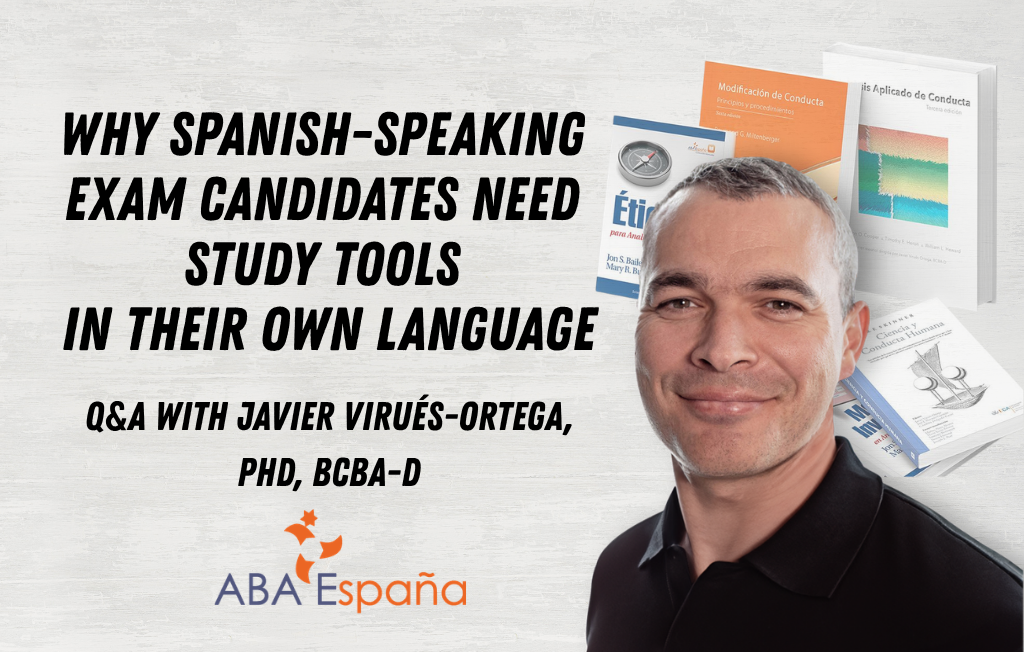
Javier Virués-Ortega, PhD, BCBA-D, of ABA España, has spent years working on that problem. Through ABA España’s publishing, training, and its collaboration with the University of Cádiz, he has helped make foundational behavior-analytic literature, including the Cooper text, available to Spanish-speaking professionals. He also served as technical reviewer for the PTB Examen ABA Manual de Estudio en Español.
We asked Dr. Virués-Ortega about the state of ABA resources in Spanish, how candidates should balance native-language understanding with English fluency, what he looked for in reviewing the translation, and where certification for Spanish-speaking countries may be headed.
For people who don’t know, what is ABA España’s mission, and who do you serve?
ABA España’s mission is to make quality, evidence-based education in applied behavior analysis accessible to Spanish-speaking communities worldwide. Our work focuses on professional training, publishing, dissemination, and, to a lesser extent, research. We serve students, behavior analysts, psychologists, educators, and other professionals interested in applying behavioral science to socially significant problems. We also develop resources for families and caregivers. Through our collaboration with the University of Cádiz (Spain), we have trained hundreds of professionals across Spain and the Americas.
How available are high-quality ABA resources in Spanish today compared to English?
The situation has improved considerably over the past decade, but there is still a substantial gap. English-speaking professionals have access to an extensive collection of textbooks, scientific publications, continuing education opportunities, and examination preparation tools. In Spanish, the range remains considerably smaller, particularly for advanced or specialized subjects. When we started publishing textbooks at ABA España, many of the foundational works of our discipline were simply unavailable in Spanish (people still relied on early editions from the 1970s). Today, we have access to a reasonably diverse contents of all kinds in Spanish.
ABA España has published more than 25 Spanish-language titles, including the Cooper book. What have you learned about what Spanish-speaking professionals need?
One important lesson is that professionals do not necessarily need simplified science; they need rigorous science presented in a language they can understand thoroughly. Translating a textbook is much more than replacing English words with Spanish equivalents. It requires developing a consistent technical vocabulary that preserves the functional meaning of behavioral concepts. We have also learned that students appreciate practical examples, clear explanations, and materials that connect foundational principles with everyday clinical decision-making. Our publications range from introductory texts to advanced works on experimental design, ethics, and verbal behavior.
Since the BCBA® exam is only offered in English, why do you believe it’s important to have exam prep tools available in Spanish?
Because competence and proficiency in English are two different things. A candidate may have an excellent understanding of reinforcement schedules, functional assessment, or experimental design but struggle to demonstrate that knowledge when the examination is administered in a second language. High-quality materials in Spanish allow students to develop a solid conceptual foundation without introducing unnecessary linguistic barriers. This is particularly important for complex scientific concepts that require precise discrimination. Of course, candidates taking certification exams must also develop familiarity with English terminology and examination questions (even for examinations that are available internationally, certification exams are typically offered in English). The goal is not to replace English preparation but to make the learning process more effective.
How should candidates think about balancing native-language understanding with English fluency?
I would encourage candidates to distinguish between learning the science and learning how to demonstrate their knowledge in English. These processes should complement one another. In the early stages, studying in Spanish can facilitate understanding of complex principles and reduce unnecessary cognitive demands. However, students should progressively incorporate English terminology, technical readings, and practice questions if they ultimately intend to take an exam in the English language. Bilingual glossaries, and side-by-side bilingual editions can be particularly useful for establishing correspondence between concepts in both languages.
When you engage with Spanish speakers taking the exam, what do they tell you is hardest about studying for a certification exam in Spanish and testing in English?
One of the most challenging aspects is the additional effort required to interpret technically complex questions in a second language, particularly under the stress of a consequential exam. ABA examinations often involve subtle distinctions between concepts, and candidates must discriminate subtleties of language that carry meaning. Small linguistic details can change the meaning of a question completely. The challenge can be particularly significant when students have studied the concepts primarily in Spanish and have had limited exposure to English examination-style questions. This challenge can distort the whole learning process as some students would lean towards “studying for the exam” rather than learning behavior analysis per se. As a teaching philosophy, we focus on professional content and discuss only in passing on the challenges posed by language barriers and examination mechanics. Having a resource like the PTB ABA Exam Study Manual in Spanish, is a great resource that we can recommend to students to deal with such challenges.
What made you want to collaborate with PTB on a Spanish edition of the Study Manual?
The collaboration represents a natural extension of what we have been doing at ABA España for many years. We have invested considerable effort in making foundational behavior-analytic literature available in Spanish in many cases on a pro bono basis. PTB has developed an established examination preparation system that organizes ample scientific content into a practical, accessible learning resource. Bringing that approach to Spanish-speaking students creates an opportunity to complement existing textbooks with a structured study tool. We were particularly interested in ensuring that the Spanish edition maintained the conceptual rigor and lexical consistency with our existing Spanish-language collection of reference materials.
As the technical reviewer, what were the critical things you looked for in the translation to be able to recommend the PTB ABA Exam Study Manual in Spanish?
My main concern was language and scientific accuracy. In behavior analysis, terminology is extremely important because relatively small changes in wording can fundamentally alter the meaning of a concept, and this is true not only when translating ABA terms, but also when providing context, examples, cultural references, etc. Ultimately, a successful translation should read naturally in Spanish while preserving the scientific precision and educational value of the original.
Besides exam preparation, how do you see the Manual being used, for example by supervisors, trainers, or clinicians working with Spanish-speaking families?
I see considerable value in using the Manual beyond certification exam preparation. University instructors may find it useful for organizing teaching activities and reinforcing important terminology. Clinicians can also use it as a quick reference when revisiting behavioral principles or explaining the conceptual basis of interventions.
Is there any progress in other Spanish-speaking countries not covered under the BACB exam toward developing their own certifications?
There is encouraging progress, although the situation varies considerably across countries. Following the BACB’s decision to restrict new certification applications geographically, professional organizations in Latin America and Spain have increasingly focused on developing training standards, promoting ethical practice, and strengthening professional recognition. Creating a professional association is not equivalent to establishing a national certification system. Developing a credible certification requires substantial infrastructure, including competency standards, supervised practice requirements, valid examinations, ethical oversight, and recognition within the local professional and regulatory environment, not to mention high-risk financial investments. All these factors have meant that a Spanish-specific certification project has not yet been realized. I am aware of promising project that may see the light in the future, let’s see what happens! In the meantime, QABA® and IBAO® are offering an alternative (although their examinations are not in Spanish as far as I know).
How can BCBA exam prep content help with country-specific certifications or the QABA and IBA, where exams are administered in Spanish?
The fundamental principles of behavior analysis are universal, regardless of the organization administering a certification examination. Therefore, PTB’s exam preparation can also provide substantial educational value to candidates pursuing QBA or IBA certification, including those taking examinations in Spanish. However, certification systems are not identical. Candidates must carefully compare the relevant competency standards and supplement their preparation with content specific to their examination.